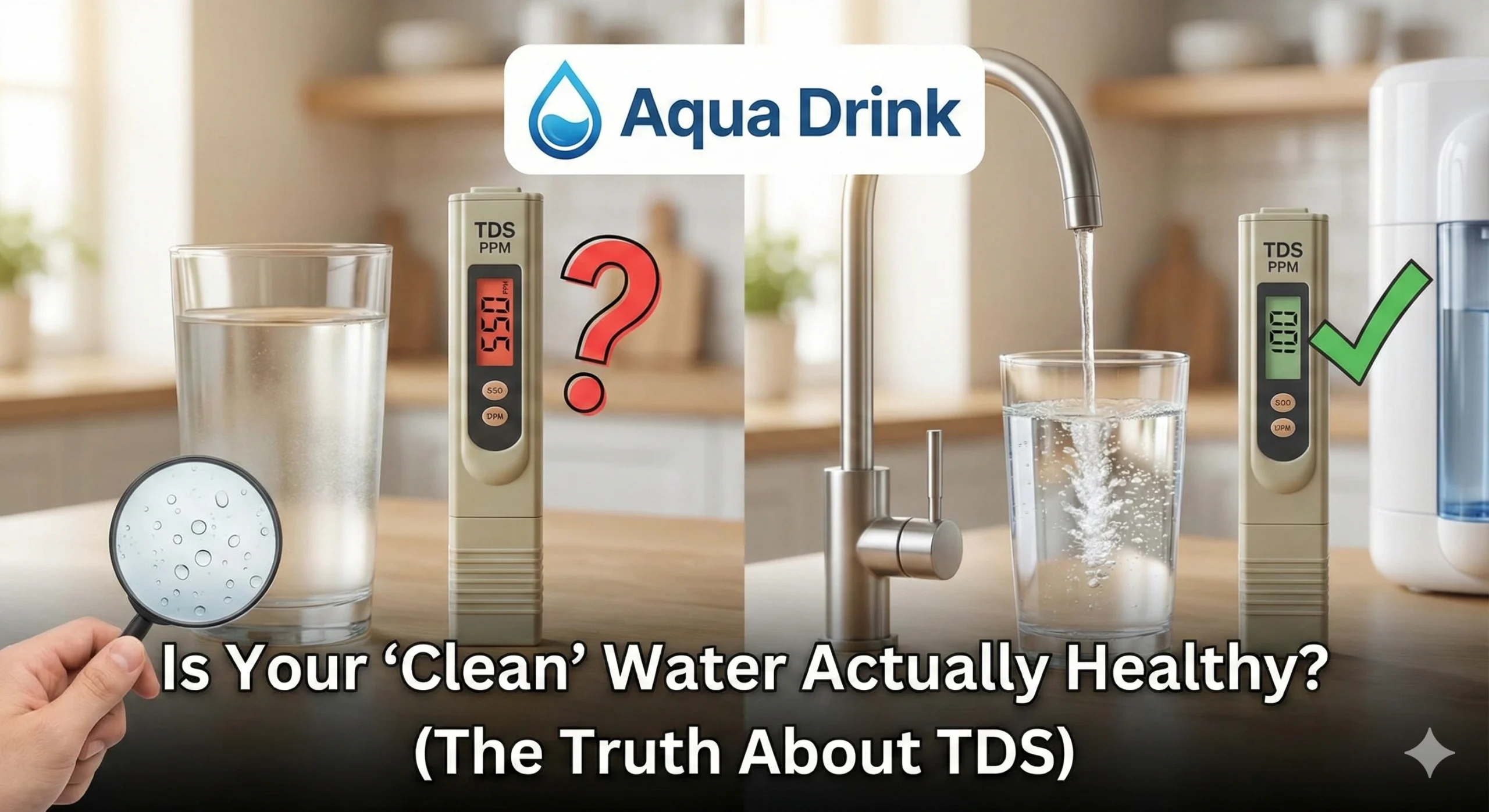
Let’s be honest for a second. When you grab a glass of water from your kitchen, you usually check one thing: Does it look clean?
If it’s clear and doesn’t smell funny, we generally assume it’s safe. But if you’ve ever tasted water at a friend’s house that felt “heavy” or had a weird metallic aftertaste, you know that clear doesn’t always mean pure.
This is where the confusion starts for most of our customers at Aqua Drink. You hear terms like “TDS,” “RO,” and “Hardness” thrown around by salespeople, and it starts to feel like a chemistry exam.
Today, I want to cut through the jargon and explain what is actually in your glass, and why the number on a TDS meter matters more than you think.
The Invisible “Seasoning” in Your Water (TDS)
First, let’s tackle the big scary acronym: TDS (Total Dissolved Solids).
Imagine you take a glass of pure water and stir in a pinch of salt, some calcium from rocks, maybe a little magnesium, and—unfortunately—perhaps some pesticide runoff or lead from old pipes. The water might still look crystal clear, but it’s now full of “dissolved solids.”
TDS is simply a measure of everything in your water that isn’t water molecules.
Here is the kicker: Not all TDS is bad.
In fact, water with zero TDS usually tastes terrible. It’s flat and bitter. That’s because we actually need minerals like calcium and magnesium for health and taste. The problem arises when the TDS gets too high (hard water that ruins your hair and kidneys) or when it contains dangerous toxins.
The “Goldilocks” Zone: How Much is Too Much?
So, if you buy a TDS meter online and test your tap water, what number are you looking for?
- Below 50: This is often what happens when you use a very strong RO (Reverse Osmosis) purifier without a mineralizer. The water is stripped of everything. It’s safe, but it’s not ideal. It can actually be slightly acidic and leach minerals from your body over time.
- 50 to 150: This is the sweet spot. The “Goldilocks” zone. The water tastes fresh and sweet, and it still retains the healthy minerals your body craves. At Aqua Drink, this is usually the target we aim for when setting up a home system.
- Above 500: Now we have a problem. The water will likely taste salty or metallic. At this level, the risk of harmful contaminants increases, and you definitely need a proper purification system.
Why Your Purifier Choice Matters
This is why buying a water purifier isn’t just about “cleaning” the water. It’s about balancing it.
If you have municipal water with low TDS, a heavy-duty RO machine might be overkill—it might strip the water until it’s “dead.” On the other hand, if you rely on borewell water (which often has very high TDS), a simple UV filter won’t touch those dissolved solids; you’ll still be drinking hard water.
The Bottom Line
Don’t just stress about the numbers. Pay attention to the taste and the source. Water is the fuel for your life, so it deserves a little more attention than just “looks clear.”
If you are ever unsure about what’s flowing out of your tap, or if your current water tastes a bit “off,” give us a shout. We can help you test it and figure out exactly what your home needs—no chemistry degree required.
Stay hydrated!