We see them everywhere. Stacked on delivery trucks, sitting outside grocery stores in the sun, and plonked upside down in office dispensers. The 20-litre blue water jar has become a lifeline for many households and offices.
It seems like the perfect solution: you don’t have to maintain a machine, you just pay as you go.
But as water experts at Aqua Drink, we often get asked: “Is this jar water actually better than a home purifier?”
The answer might surprise you. While the water inside might have started out clean, the journey it takes to get to your glass is often where the problems begin.
1. The “Sunlight” Factor
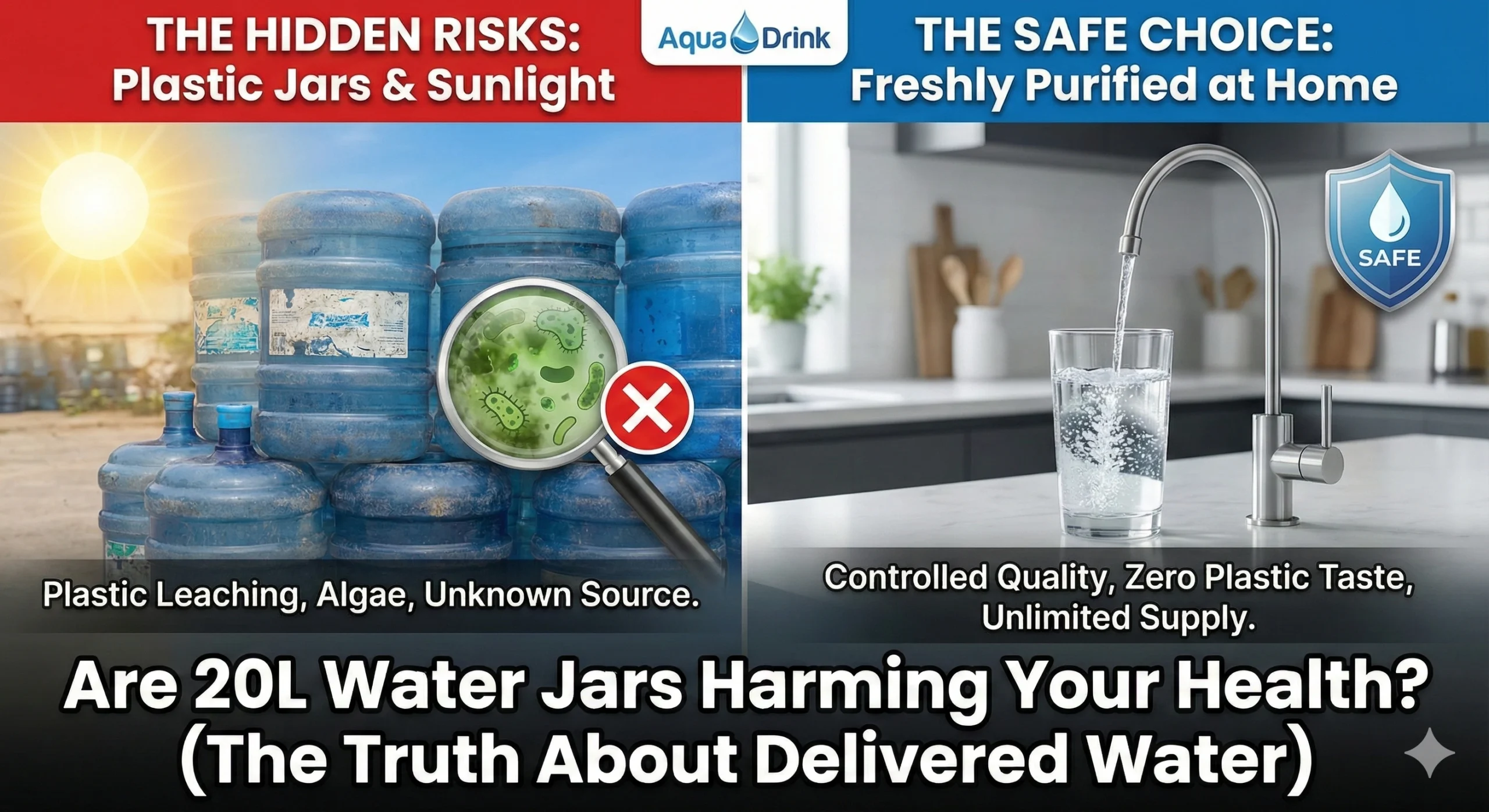
Next time you pass a shop selling these jars, look at where they are stored. Usually, they are stacked outside, baking in the direct sunlight for hours.
Most of these jars are made of plastic. When plastic heats up (even food-grade plastic), it can release microscopic chemicals and microplastics into the water. So, while the water might be bacteria-free, you might be drinking a “chemical soup” that tastes like… well, plastic.
2. The Cleaning Question
These jars are reused hundreds of times. That’s good for the environment, but only if they are sterilized perfectly between uses.
In many unregulated bottling plants, the “cleaning” process is sometimes just a quick rinse with tap water. If the previous user had the jar in a dirty environment, or if moisture was left inside for weeks, biofilm (a slimy layer of bacteria) can grow on the inside walls. If you’ve ever noticed a faint green tinge at the bottom of a jar, that’s algae. And you definitely don’t want to drink that.
3. The “Unknown Source” Mystery
When you turn on your own RO machine, you know exactly where the water came from (your tap) and how it was treated.
With generic water jars, the label might say “Purified Water,” but the source is often a mystery. Is it municipal water? Borewell water? Was it filtered yesterday or last month? Without strict quality control, you are essentially trusting a stranger with your health.
4. The Cost Calculation
Let’s talk money. A typical jar costs anywhere from ₹30 to ₹50 depending on the brand. If a family consumes one jar every two days, that’s roughly ₹600 a month. That’s nearly ₹7,200 a year!
For that same price, you could maintain a top-tier home RO system that gives you unlimited fresh water, right in your kitchen, without the back-breaking work of lifting heavy jars.
The Bottom Line
We aren’t saying all jar water is bad. In a pinch, it’s certainly better than drinking directly from a questionable tap.
But as a permanent solution? It’s risky, expensive, and often less healthy than you think. There is a certain peace of mind that comes with pressing a button in your own kitchen and watching fresh, sparkling water fill your glass—zero plastic taste, zero heavy lifting.
If you are tired of the “jar struggle,” give us a call. We can help you calculate exactly how much you’d save by switching to your own system.
Stay safe, stay hydrated!